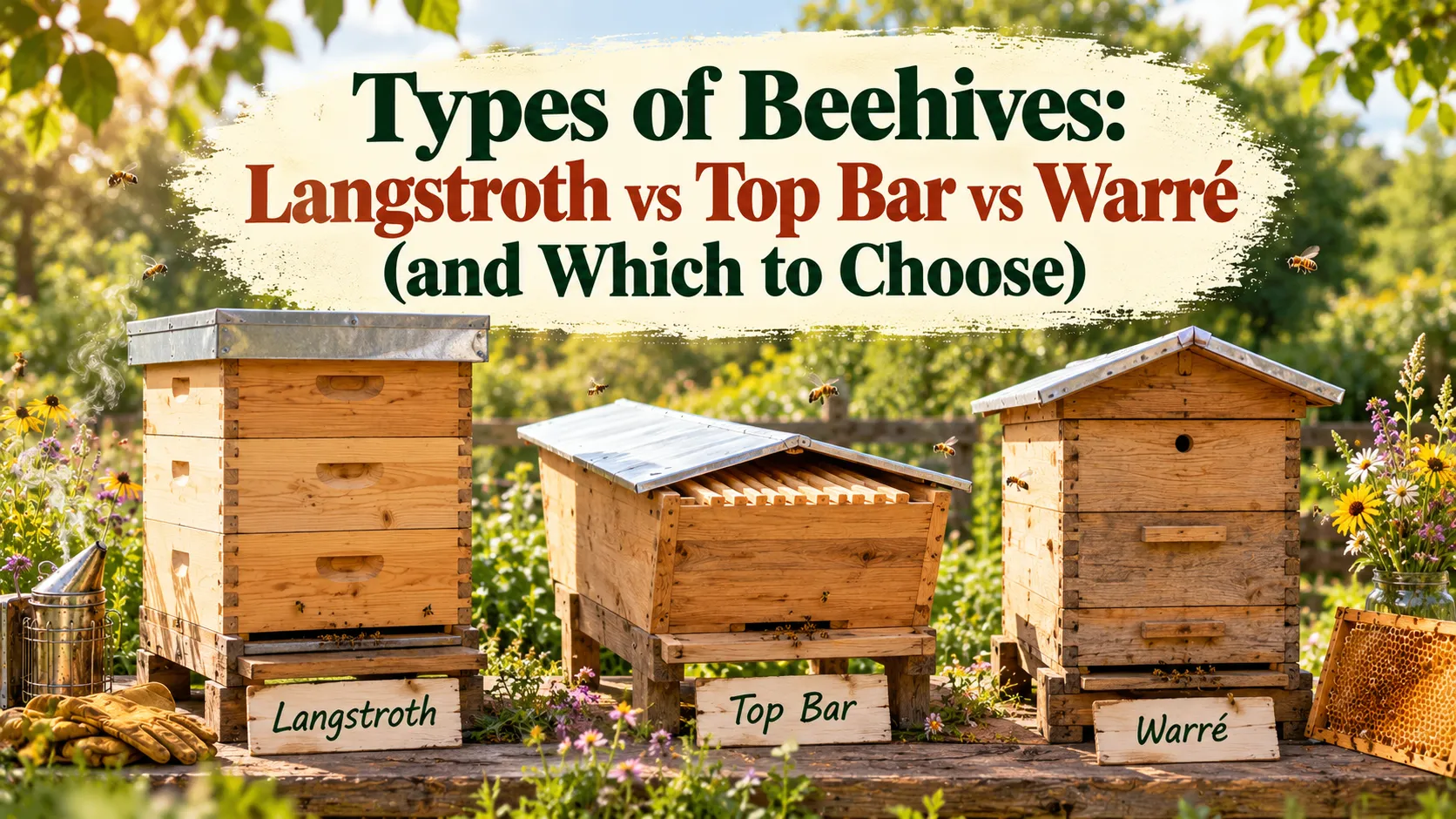
Choosing a hive is one of the first real decisions in beekeeping, and it’s hard to undo. Once you’ve bought bees, frames, and boxes for one system, switching costs money and stresses the colony. This guide compares the hive types you’ll actually see in the US, explains the tradeoffs that matter, and ends with a simple decision guide.
It draws on extension guidance from Arkansas, Montana State, Alaska, and Georgia, and on state apiary laws. If you’re just getting started, our step-by-step beginner’s guide shows where choosing a hive fits in your first year.
Hive types compared
| Hive | Layout | Comb | Honey yield | Lifting | Beginner fit | US parts and nucs |
|---|---|---|---|---|---|---|
| Langstroth | Vertical stack of boxes | Removable frames, usually with foundation | Highest | Heavy: full boxes can weigh 50 pounds or more | Best | Easiest to find |
| Top bar | One long horizontal box | Comb hangs from bars, no frames | Lower, but more beeswax | Light: one comb at a time | Good, if you can learn without much local help | Limited; standard nucs don’t fit |
| Warré | Vertical stack of small boxes | Comb hangs from bars | Lower | Lighter boxes, but you add boxes underneath | Fair | Limited |
| Horizontal Langstroth / Layens | One long horizontal box | Removable frames | Medium to high | Light: no box lifting | Good | Moderate; horizontal Langstroth takes standard frames |
| Flow Hive | Langstroth-style stack | Flow frames in the honey super | Similar to Langstroth | Like Langstroth for brood boxes | Good, with the same skills as Langstroth | Brand-specific super parts |
A complete Langstroth hive is the cheapest place to start. In October 2026, Mann Lake listed an unassembled 10-frame hive kit at $149.99 and assembled kits from about $163 to $237. Top bar, Warré, and Flow hives usually cost more for the same capacity, and prices vary widely by maker. Our guide to beekeeping startup costs has full first-year budgets.
Langstroth hive
The Langstroth hive was designed by American beekeeper Lorenzo Langstroth in 1851. His key insight was bee space: a gap of about 1/4 to 3/8 inch that bees leave open rather than filling with comb or propolis. Arkansas Extension explains that by building that gap between every part, Langstroth made a hive where each frame could be lifted out and inspected without tearing the nest apart. It became the worldwide standard for practical beekeeping and commercial honey production. For box dimensions, frame sizes, and beginner configurations, see our complete Langstroth hive guide.
A Langstroth hive is a stack of rectangular boxes, each holding 8 or 10 removable frames:
- Brood boxes at the bottom, where the queen lays eggs
- Honey supers on top, where the bees store surplus honey
- A bottom board, inner cover, and outer cover
For a labeled diagram of every piece, see parts of a beehive explained.
Pros:
- Standard parts. Boxes and frames from different suppliers fit together, and parts are easy to buy nationwide.
- Easy honey harvest. Frames can be uncapped and spun in an extractor, and the empty comb goes back to the bees to refill, which Montana State Extension notes isn’t possible with top bar hives.
- Modular. You add boxes as the colony grows and take them away as it shrinks.
- Support. Most mentors, classes, and books teach on Langstroth hives, and nucs are sold on Langstroth frames.
Cons:
- Heavy lifting. Montana State notes that a full medium super can weigh 50 pounds, and UAF Extension puts full boxes at 50 to 100 pounds. You’ll lift boxes off the colony at every full inspection.
- More disruptive inspections, since you open the colony from the top.
8-frame vs 10-frame Langstroth
Both are standard. The difference is width, weight, and capacity:
- 8-frame boxes are narrower and lighter. UGA recommends them for beginners for exactly that reason.
- 10-frame boxes are the traditional standard and hold more per box, so you need fewer boxes.
Pick one width and stick with it. Boxes, covers, and bottom boards don’t mix between the two. Many beekeepers also use only medium boxes throughout, so every frame fits every box and no box is too heavy to lift.
Top bar hive
A top bar hive is a long horizontal box with wooden bars laid across the top. The bees build comb hanging down from each bar, without frames or foundation. Arkansas Extension describes the two common designs:
- Kenyan top bar hives have sloped sides. Because comb is naturally rounded at the bottom, bees tend not to attach it to sloped walls, which makes combs easier to remove.
- Tanzanian top bar hives have straight sides.
A movable divider called a follower board controls how much space the colony has. As the colony grows, you move it back and add empty bars.
Pros:
- No heavy lifting. You lift one comb at a time instead of whole boxes, and the hive sits at waist height.
- Simple and cheap to build from basic lumber, with no foundation required.
- Gentler inspections. UAF notes that with the hive opened from the top one bar at a time, fewer bees fly up around you.
- More beeswax. You harvest the whole comb, honey and wax together, which suits comb honey and wax crafts.
Cons:
- Less honey. Arkansas Extension notes top bar hives tend to produce less surplus honey per hive than Langstroth hives, partly because bees must rebuild comb after each harvest.
- Fragile comb. Combs are attached only along the top, and a full comb can weigh 5 pounds or more, so they can break if tilted.
- Crooked comb needs correcting early, or bees build comb across several bars.
- Standard nucs don’t fit. You’ll need a package, a swarm, or a seller who offers top bar nucs.
- Cold winters. UAF notes overwintering may be harder in a horizontal hive, and anecdotal reports say top bars work better in warmer states.
For dimensions, Kenyan vs Tanzanian designs, and how to manage one, see top bar hive explained.
Warré hive
The Warré hive, developed by French priest Émile Warré and sometimes called “the people’s hive,” is a vertical stack of small, square boxes with top bars instead of frames. Unlike a Langstroth, new boxes are added at the bottom (called nadiring), so the bees build downward as they would in a hollow tree. Montana State describes a top box (the “quilt”) filled with insulating material such as wood shavings or wool.
Pros:
- Smaller, lighter boxes
- Less frequent inspection, which appeals to beekeepers who prefer a hands-off, natural approach
- Insulated top, which helps with moisture and cold
Cons:
- Adding boxes underneath means lifting the whole stack.
- Lower honey yield. UAF notes reports of lower honey production.
- Hard to inspect closely, and few local mentors use them, so you’ll learn largely on your own.
Horizontal Langstroth and Layens hives
Horizontal hives combine the frames of a Langstroth with the no-lifting layout of a top bar:
- A horizontal Langstroth is a long box that holds standard Langstroth deep frames side by side. It accepts a standard nuc, and the frames are compatible with any Langstroth equipment.
- A Layens hive uses tall, narrow frames in a horizontal box. It’s popular in Eastern Europe and is gaining interest in the US.
These suit beekeepers who want frames and standard equipment but can’t lift heavy boxes. The tradeoff is that the hive is large and heavy to move, and you can’t add capacity by stacking.
Flow Hive
The Flow Hive is a Langstroth-style hive with special Flow frames in the honey super. The frames have split plastic cells. When the honey is capped, you turn a key, the cells shift, and honey drains out through a tube without opening the hive or using an extractor. The brood boxes below are managed like any Langstroth.
It’s a different way to harvest, not a different way to keep bees. You still need to inspect the brood, manage swarming, and monitor mites. Our full Flow Hive review covers its pros, cons, and the research.
Other hive types
- Observation hives have glass or acrylic sides so you can watch the colony. They’re popular for schools and nature centers, but they’re too small to produce honey or overwinter well on their own.
- Skeps are traditional woven straw baskets. The comb can’t be removed for inspection, so they’re impractical, and in many states illegal, for keeping live colonies. Today they’re mostly decorative.
- Log hives (bee gums) are hollowed logs, historically common in the eastern US. Like skeps, they have fixed comb.
- Plastic hives are Langstroth-sized boxes made of plastic. They’re durable and don’t need painting, and many work with standard frames.
- Polystyrene hives are insulated foam boxes common in Europe. Their insulation can help colonies in cold climates, and some are made in Langstroth dimensions.
Which beehive is best for beginners?
For most US beginners, a Langstroth. That’s not because it’s perfect, but because everything else in beekeeping is built around it: nucs, mentors, classes, books, extractors, and spare parts. If something goes wrong in your first year, it’s far easier to get help with a Langstroth.
Use this quick guide:
- Want the most help, honey, and spare parts? Langstroth. Choose 8-frame or all-medium boxes to keep the weight down.
- Have a bad back or can’t lift 50 pounds? A horizontal Langstroth, which takes standard nucs and frames, or a top bar hive.
- Want minimal intervention and comb honey or beeswax? A top bar or Warré hive. Accept lower yields, and find a local beekeeper who uses the same type.
- Starting with a nuc? Langstroth or horizontal Langstroth. A standard nuc’s frames won’t fit a top bar or Warré hive.
- Live in a very cold climate? A well-insulated Langstroth is the most common choice. UAF’s author plans a double-deep, insulated Langstroth for Anchorage.
Whatever you choose, use the same hive type and frame size for every hive, so you can move frames between colonies. Then see our rundown of beginner equipment for what to buy with it. For specific picks, see our Langstroth bee hive kits compared.
Hive types and the law
Arkansas Extension notes that most places in the US require beekeepers to use some type of movable-comb hive. Inspectors need to lift out individual combs to check for diseases like American foulbrood. Some state laws are explicit:
- Nevada makes it unlawful to keep bees “in other than movable frame hives” (NRS 552.230). Hives that aren’t corrected can be destroyed.
- South Dakota requires movable frames in all hives, with brood comb built in the frames so any frame can be removed without damaging the others (SDCL 38-18-8).
That rules out skeps and log hives for managed colonies in those states. Top bar hives have removable combs, but some laws specifically say “frames,” so if you choose a top bar or Warré hive, check with your state apiarist first. Rules vary by state, so confirm with your state department of agriculture before you buy.
Common questions
Which beehive is best for beginners?
For most US beginners, an 8-frame or 10-frame Langstroth. It produces the most honey, and nucs, mentors, classes, and spare parts are all built around it. If lifting is a problem, consider a horizontal Langstroth, which takes standard frames and nucs.
Can I put a nuc in a top bar hive?
Not a standard one. Nucs are sold on Langstroth frames, which don’t fit top bar hives. Top bar beekeepers usually start with a package or a swarm, or buy from a seller who offers top bar nucs.
What is a super in a beehive?
A honey super is a box placed on top of the brood boxes in a Langstroth hive, where bees store surplus honey for the beekeeper to harvest. Supers are often shallower than brood boxes, so they’re lighter to lift when full.
Are plastic beehives good?
They can be. Plastic hives are durable, don’t need painting, and many fit standard Langstroth frames. Some beekeepers find bees accept wood or wax-coated foundation more readily, so check that the hive works with the frames you plan to use.
What is a natural beehive?
Usually a hive that lets bees build their own comb without foundation, such as a top bar or Warré hive, managed with minimal intervention. A wild colony living in a hollow tree is also sometimes called a natural beehive.
Sources and further reading
- University of Arkansas Cooperative Extension, Basic Beekeeping 2: The Bee Hives
- Montana State University Extension, Housing Honey Bees
- University of Alaska Fairbanks Cooperative Extension, Choosing the Perfect Hive
- UGA Field Report, A beginner’s guide to successful beekeeping
- Nevada Revised Statutes 552.230, Bees and Apiaries
- South Dakota Codified Laws 38-18, Bees and Honey
- Mann Lake, 10-frame complete hive kits (prices checked October 2026)