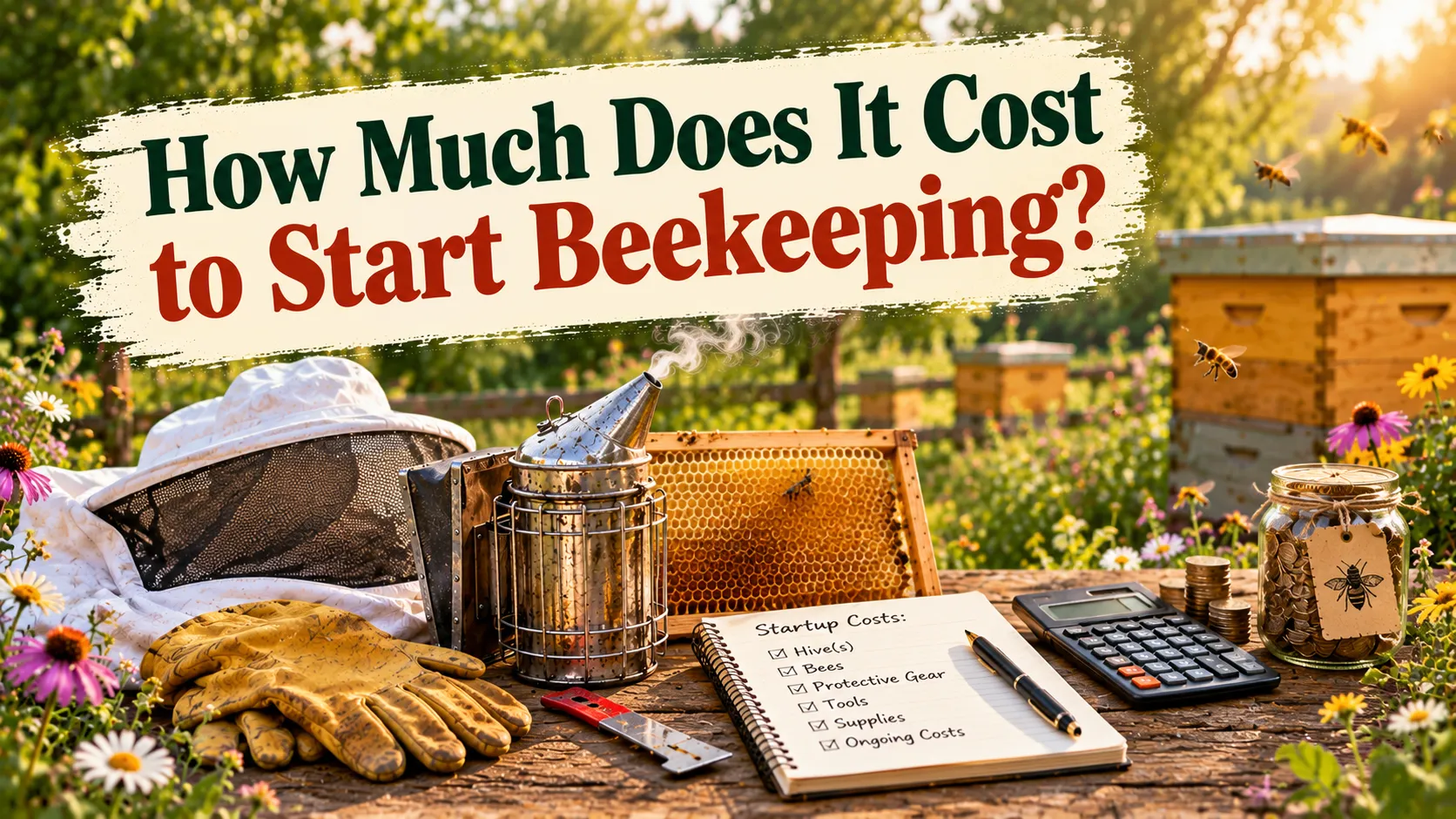
Beekeeping startup costs depend on three choices: how many hives you start with, whether you buy a package or a nuc, and how much assembly you’re willing to do. This page breaks the total down item by item, then puts the numbers into three sample budgets for one and two hives.
Startup cost breakdown
| Item | Low | Typical | Notes |
|---|---|---|---|
| Bees (3 lb package) | $135 | $170–$210 | Spring 2026 listings ran $135 to $230 |
| Bees (5-frame nuc) | $205 | $215–$275 | Higher price, faster start |
| Complete hive, 10-frame | $150 unassembled | $165–$240 assembled | One brood box, frames, covers, bottom board |
| Second brood box with frames | $80 unassembled | About $100 assembled | Most colonies need two boxes in year one |
| Jacket or suit with veil | $50 | $80–$250 | Ventilated suits cost the most |
| Gloves | $15 | $20–$35 | |
| Smoker | $25 | $35–$60 | Stainless steel with a heat shield |
| Hive tool | $8 | $10–$20 | Buy two |
| Feeder | $10 | $15–$30 | One per hive |
| Mite monitoring kit | $10 | $15–$40 | A DIY jar costs less |
| Sugar for spring feeding | $25 | $30–$40 | Per new colony; varies with your nectar flow |
Bees: package vs nuc vs swarm
Packages (about 3 pounds of bees and a caged queen) were listed for spring 2026 at around $135 to $230. Carolina Honey Bee Company listed one at $145, Lappe’s Bee Supply in Iowa at $185, and The Bee Supply at $209 to $229, depending on the queen’s line.
Nucs (a small established colony, usually on five frames) ran about $205 to $275. Sierra Honey Farm listed $205 to $225 depending on quantity, Lappe’s $250, and The Bee Supply $274. UGA’s beginner guide notes that nucs have a higher success rate, and that’s why they cost more.
Swarms are free if you catch one, but you can’t schedule them. They’re a bonus, not a plan for your first colony.
Many sellers are pickup only, and most sell out before spring. Order in fall or early winter. Our step-by-step guide for beginners explains the timing.
The hive
At Mann Lake (October 2026), an unassembled complete 10-frame hive with foundation was listed at $149.99. Assembled complete kits ran from about $163 to $237, depending on whether a second box was included. Betterbee’s assembled basic beginner kits, which add a smoker, hive tool, gloves, and veil, were listed from $259. For specific picks, see our guide comparing beehive kits.
Two things change the hive budget the most:
- Assembled vs unassembled. Unassembled saves money but takes a few hours with glue, nails, and exterior paint.
- A second brood box. Many single-box kits need a second deep or medium within the first two months. Budget for it from the start.
Protective gear
A jacket with an attached veil is the most common choice for beginners and usually the cheapest full-coverage option. Full suits cost more, and ventilated mesh suits (popular in the South) cost the most. Add gloves. Gear is a one-time cost that doesn’t grow with your number of hives.
Tools and feeders
A smoker, a hive tool, and one feeder per hive cover the basics. Starter tool bundles can save a little, but check what’s inside. Our guide to essential beekeeping gear shows which items you need before the bees arrive and which can wait.
Mite monitoring and treatment
A mite testing jar costs little or can be homemade. Treatments are a separate, recurring cost once your counts call for them. Leaving them out of the budget is the most expensive mistake, because untreated colonies often die in their first winter.
Three sample budgets
These totals add up the ranges above. “1 hive” includes one hive and one colony. “2 hives” adds a second hive, a second colony, and a second feeder, but not more gear.
Budget setup
Unassembled 10-frame hive, an unassembled second deep, a package, a jacket with veil, and basic tools.
| 1 hive | 2 hives | |
|---|---|---|
| Hive and second brood box | $230 | $460 |
| Bees (package) | $135–$185 | $270–$370 |
| Jacket with veil, gloves | $65–$110 | $65–$110 |
| Smoker and hive tool | $33–$55 | $33–$55 |
| Feeder, mite kit, sugar | $45–$80 | $80–$140 |
| Total | About $510–$660 | About $910–$1,135 |
Standard setup
An assembled hive with a second box, a nuc, a full suit, and mid-range tools.
| 1 hive | 2 hives | |
|---|---|---|
| Assembled hive combo and extra deep | $330–$337 | $660–$674 |
| Bees (nuc) | $205–$275 | $410–$550 |
| Full suit, gloves | $100–$185 | $100–$185 |
| Smoker and hive tool | $45–$80 | $45–$80 |
| Feeder, mite kit, sugar | $60–$110 | $100–$180 |
| Total | About $740–$990 | About $1,315–$1,670 |
Premium setup
An all-in-one assembled starter kit with tools and a feeder included (Mann Lake’s Premium Starter Kit was listed at $439.99), an extra deep, a nuc, and a ventilated suit.
| 1 hive | 2 hives | |
|---|---|---|
| Premium starter kit and extra deep | $540 | $1,080 |
| Bees (nuc) | $250–$275 | $500–$550 |
| Ventilated suit, gloves | $175–$290 | $175–$290 |
| Mite kit | $20–$40 | $20–$40 |
| Total | About $985–$1,145 | About $1,775–$1,960 |
Specialty hives such as the Flow Hive generally cost more than a standard Langstroth kit. See our Flow Hive review for current model prices. The two-hive premium column assumes a second starter kit for simplicity. In practice you’d buy just the second hive and save the duplicate tools.
Ongoing yearly costs after year one
Year two is cheaper, but it isn’t free. Per hive, plan for:
- Mite treatments. Most colonies need at least one or two treatments a year. Cost depends on the product.
- Sugar. Fall feeding if stores are light, and spring feeding for splits or weak colonies.
- Replacement queens. One price index of online sellers put the average asking price for a queen at about $43 in September 2026.
- More boxes and frames. A growing colony needs honey supers, and old brood comb should be replaced over time.
- Replacing dead colonies. This is the big one. The Apiary Inspectors of America survey estimated that backyard beekeepers lost 54.8% of their colonies between April 2025 and April 2026. Budget for at least one replacement package or nuc a year, or plan to make splits from surviving colonies.
Costs beginners forget
- Registration fees. Some states require registration, and a few charge a fee. Many states don’t. Check your state department of agriculture.
- A second brood box, which isn’t in every “complete” kit.
- A mite testing kit and treatments.
- Honey extraction. An extractor is a large purchase. In year one you usually won’t need it, because there’s rarely a harvest, and many clubs lend or rent extractors to members.
- Bear fencing where bears are present. Penn State recommends installing it before the bees arrive.
- A beginner class. Local club courses usually cost about $50 to $150, and university online courses about $160 to $175. Compare options in our beekeeping classes guide.
- Your time. Assembling hives, inspecting every week or two in spring, and going to club meetings.
How to start beekeeping on a budget
- Join a club first. Clubs often organize group orders for bees and woodenware, lend extractors, and connect beginners with members selling local nucs.
- Buy unassembled woodenware. It’s often the biggest saving on the hive.
- Start with a package instead of a nuc, if you accept a slower start and a higher risk.
- Be careful with used equipment. Used boxes and frames can carry American foulbrood spores. Buy only from a known, inspected source, or skip it.
- Catch a swarm in year two instead of buying your second colony.
- Don’t buy harvest gear in year one.
Is beekeeping worth it financially?
Usually not in the first year or two. A new colony rarely produces surplus honey in its first season, and UGA advises that year one is about getting the colony through winter, not harvesting. Hobby beekeeping pays off in pollination for your garden, local honey in later years, and what you learn. If you’re hoping to break even, plan for at least two hives, keep colony losses low with mite monitoring, and treat honey sales as a year-three goal.
Common questions
How much does a beehive with bees cost?
A complete 10-frame hive plus a colony cost roughly $285 to $515 with spring 2026 prices: about $150 to $240 for the hive and $135 to $275 for the bees, depending on package vs nuc. Protective gear and tools are extra.
Is a nuc or a package cheaper?
A package is cheaper. Spring 2026 packages ran about $135 to $230, compared with about $205 to $275 for a 5-frame nuc. Nucs cost more because they arrive as an established colony with drawn comb, brood, and a laying queen.
How much does beekeeping cost per year?
After year one, ongoing costs per hive are mostly mite treatments, sugar, occasional replacement queens, and new boxes and frames. The largest variable is replacing colonies that die over winter.
Is it cheaper to build your own hive?
It can be if you have tools and scrap lumber, but frames are hard to make accurately at home and the dimensions must be exact. Many beekeepers build boxes and buy frames. Unassembled kits are a middle option.
Next steps
To price your own setup, plug your choices into the free beekeeping startup cost calculator. It also estimates your year-two costs. Use these ranges to set your budget, then shop from the starter gear checklist so you buy the essentials first. If you haven’t mapped out your first season yet, our beginner’s guide to starting a hive walks through all seven steps with a month-by-month timeline.
Sources and further reading
- Mann Lake, 10-frame unassembled complete hive kit with foundation (listing checked October 2026)
- Mann Lake, 10-frame complete hive kit combo (listing checked October 2026)
- Mann Lake, Premium Starter Kit (listing checked October 2026)
- Betterbee, beginner hive kits
- The Bee Supply, 2026 nucs, singles, and packages
- Lappe’s Bee Supply, 2026 3 lb package
- Carolina Honey Bee Company, package bees
- Sierra Honey Farm, 2026 bee nuc
- Swarmed, bee and honey price index
- UGA Field Report, A beginner’s guide to successful beekeeping
- Penn State Extension, Beekeeping: Honey Bees
- Apiary Inspectors of America, 2025–2026 US Beekeeping Survey (preliminary results)